Drive or walk through any neighborhood in Santa Ana, California, and you will notice the concrete curbs and gutters that line every street. These structures are so common that they go largely unnoticed until they are damaged. Cracked, crumbling, or sunken curbs and gutters are more than an eyesore; they represent a failure in the drainage and safety infrastructure that supports Santa Ana’s streets, sidewalks, and adjacent properties. Understanding what curbs and gutters are, why they deteriorate, how they are repaired, and why timely repair matters is important knowledge for Santa Ana homeowners, property managers, and business owners. This article provides a comprehensive overview of Curb And Gutter Repair Santa Ana.
What Are Curbs and Gutters?
Curbs and gutters are among the most fundamental elements of urban infrastructure. Though they are often treated as a single system, they serve distinct functions:
Curbs: A curb is the raised concrete edge that runs along the boundary between a roadway or parking area and adjacent surfaces such as sidewalks, lawns, or landscaped areas. Curbs define the edge of the travel way, protect adjacent areas from vehicle encroachment, provide structural edge support for the pavement, and give pedestrians a clear boundary between the sidewalk and the street.
Gutters: The gutter is the sloped concrete channel that runs alongside the curb, typically at the base of the curb face extending toward the travel lane. Its primary function is to collect and direct stormwater runoff along the edge of the road toward catch basins, storm drains, or other outlets. Without gutters, rainwater would flow uncontrolled across pavement surfaces, potentially flooding low points and eroding landscaped areas.
Combined, curbs and gutters manage both traffic safety and water management two critical functions in a city like Santa Ana, which experiences concentrated winter rainfall events that must be channeled effectively to prevent flooding and property damage.
Types of Concrete Curbs Used in Santa Ana
Santa Ana streets and parking areas incorporate several different curb designs, each suited to specific applications:
Vertical Curbs: Feature a near-vertical face that rises from the gutter to the top of the curb. These provide strong vehicle containment and clear delineation of the roadway edge. Common in arterial streets and commercial areas throughout Santa Ana.
Slanted (Rollover) Curbs: Feature a sloped rather than vertical face, allowing vehicles to mount the curb more gradually. Used in areas where occasional vehicle access across the curb edge is expected, such as some parking lots and residential street applications.
Barrier Curbs: Higher and more substantial than standard vertical curbs, barrier curbs are used in areas where positive vehicle containment is required, such as at highway medians, bridge abutments, or protected bicycle lanes.
Mountable Curbs: Designed specifically to allow vehicles to cross them safely, often used in parking lots or in locations where emergency vehicle access needs to be maintained without a traditional curb break.
Combined Curb and Gutter (Monolithic): In many Santa Ana streets, the curb and gutter are poured as a single, integrated concrete unit. The City of Santa Ana’s street standards specify dimensions and configurations for these structures.
Why Curbs and Gutters in Santa Ana Deteriorate
Concrete curbs and gutters have a substantial service life, but they are subject to a range of deterioration mechanisms:
Vehicle Impact Damage: Vehicles that mount curbs whether accidentally, during deliveries, or due to driver error exert lateral and vertical forces that chip, crack, or break curb sections.
Tree Root Intrusion: Santa Ana’s mature street trees are one of the city’s assets, but their roots can exert tremendous pressure on adjacent concrete structures. As roots grow beneath curbs and gutters, they lift and crack the concrete, creating tripping hazards and disrupting drainage.
Ground Settlement: Subsurface soil movement, changes in soil moisture, or poor original compaction can cause the ground beneath a curb or gutter section to settle, leaving the concrete unsupported and prone to cracking or sinking.
Water Erosion: Poorly maintained gutters that allow water to infiltrate beneath the concrete through cracks or at joints gradually erode the subbase material, causing the structure to sink, tilt, or crack.
Freeze-Thaw Cycles: While Santa Ana does not experience severe winter freezing, the city does see occasional cold nights that, combined with moisture, can cause minor spalling or surface deterioration of concrete over time.
Age and Material Fatigue: Like all concrete structures, curbs and gutters have a finite service life. Older installations throughout Santa Ana’s established neighborhoods may simply reach the point where deterioration outpaces repair, requiring full replacement.
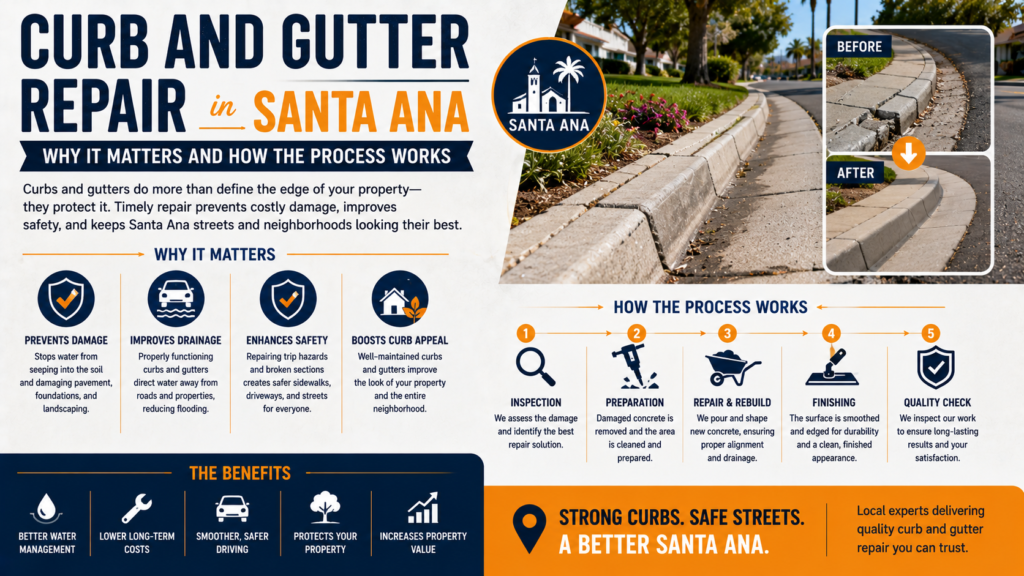
The Curb and Gutter Repair Process
Repairing damaged curbs and gutters in Santa Ana involves a structured process that restores structural integrity and drainage function:
Assessment: A contractor evaluates the extent and cause of the damage. Minor surface spalling may require only cosmetic repair, while sections with cracks extending through the full depth, significant displacement, or root-caused upheaval typically require removal and replacement of the affected section.
Saw Cutting: When a section must be replaced, a concrete saw is used to make clean, straight cuts at the boundaries of the damaged area. This prevents the removal work from disturbing adjacent undamaged concrete.
Demolition and Removal: The damaged concrete is broken up using jackhammers or hydraulic breakers and removed from the site. Any root systems causing the damage are addressed either by root pruning or, when necessary, coordinating with the City of Santa Ana’s street tree management program.
Subbase Preparation: The exposed subgrade is assessed, repaired if necessary, and compacted to provide a stable foundation for the new concrete.
Form Setting: Forms are placed to define the dimensions of the new curb and gutter section, following the City of Santa Ana’s standard specifications for curb height, gutter width, and slope.
Concrete Placement and Curing: Fresh concrete is placed, consolidated, finished, and allowed to cure. The new section is matched to the existing curb profile and height as closely as possible.
Cleanup and Restoration: Surrounding areas including any disturbed sidewalk, landscaping, or pavement are restored to proper condition.
The Connection Between Curb and Gutter Condition and Property Drainage
In Santa Ana, where the winter rainy season brings concentrated precipitation, the condition of curbs and gutters has a direct effect on how well properties drain during storm events. A gutter section that has settled and lost its slope no longer channels water effectively instead, water ponds in the low spot, potentially overflowing onto sidewalks or adjacent landscaping. A broken curb section may allow water to escape the drainage channel entirely, eroding soil or undermining adjacent pavement.
Property owners along streets with drainage issues should examine the condition of the curb and gutter at the front of their property. Damaged sections near an individual property may be the responsibility of the property owner to repair, depending on the nature of the damage. The City of Santa Ana’s Public Works Department maintains street curbs and gutters within the public right-of-way, but damage caused by private property activities such as tree roots from a property’s front yard tree may be the owner’s responsibility.
Curb and Gutter Repair for Commercial Properties in Santa Ana
Commercial property owners in Santa Ana have particular reasons to maintain curbs and gutters in good condition:
Liability: A damaged curb that creates a trip hazard for pedestrians or causes vehicle damage presents a potential liability concern. Addressing damage promptly limits this exposure.
Stormwater Compliance: Businesses in Santa Ana are subject to stormwater regulations that require on-site drainage to be maintained in proper working order. Damaged gutters that allow uncontrolled stormwater flow may create compliance issues.
Property Appearance: Well-maintained curbs and gutters contribute to the overall appearance of a commercial property, signaling to customers and visitors that the property is properly managed.
ADA Compliance: Damaged curbs at accessible pedestrian routes including areas near handicap ramps, crosswalks, and building entrances may create ADA compliance concerns that require prompt attention.
Frequently Asked Questions About Curb and Gutter Repair in Santa Ana
Who is responsible for curb and gutter repair the city or the property owner? Responsibility varies depending on the location and cause of damage. Santa Ana’s Public Works Department maintains public street infrastructure, but damage caused by private activities or located on private property is typically the property owner’s responsibility. The city’s website provides guidance on reporting and responsibility.
Can curbs be repaired rather than replaced? Minor surface damage such as spalling or small chips can sometimes be repaired using specialized concrete patching materials. However, sections with through-cracks, significant displacement, or compromised drainage slope generally require replacement to restore proper function.
How long does a curb replacement section take? A single damaged section can typically be replaced in one day of work, with a curing period of 24 to 48 hours before the area is returned to normal use.
Is a permit required for curb and gutter work in Santa Ana? Work within the public right-of-way including replacing curb and gutter sections adjacent to the street typically requires an encroachment permit from the City of Santa Ana’s Public Works Department.
Conclusion
Curbs and gutters are silent workhorses of Santa Ana’s urban infrastructure. When they fail, the consequences ripple outward affecting drainage, pedestrian safety, property appearance, and ADA compliance. Understanding what causes curb and gutter deterioration and how repair work is performed gives property owners and managers the knowledge they need to address problems early and effectively.